
Heritage Buildings Jet Washing
Heritage building jet washing uses gentle, specialist techniques to restore and preserve historic structures across Newcastle, Sunderland, Teesside, Northumberland, and County Durham. The North East’s wealth of heritage—from Durham’s Norman cathedral and Newcastle’s Georgian terraces to Northumberland’s medieval castles and Sunderland’s Victorian maritime buildings—demands expert cleaning that protects these irreplaceable fabrics.
Listed building legislation provides statutory protection for heritage structures in the North East. Any work affecting their character or appearance requires listed building consent from the local planning authority, including cleaning that could alter surfaces or damage historic fabric. Professional heritage cleaning operators understand these requirements and work within this consent framework to protect the region’s architectural legacy.
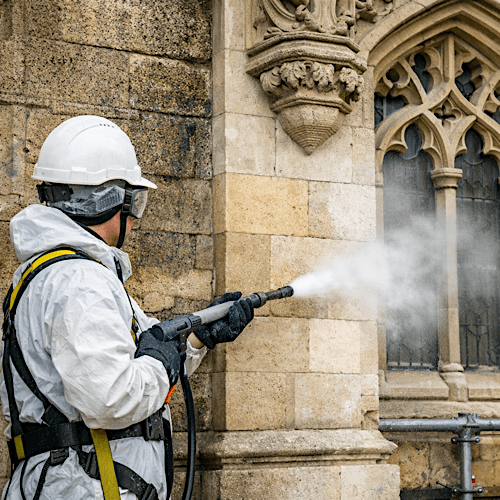
Doff steam cleaning is the predominant method for heritage building jet washing across the North East. Delivering superheated steam at temperatures up to 150 degrees Celsius (a process where water is heated into vapour), but at minimal pressure, Doff systems remove biological growth (such as moss or algae), pollution deposits, paint layers, and surface contamination without the mechanical abrasion—that is, surface scratching or wearing away—that conventional jet washing causes. This thermal cleaning approach preserves original tool marks, intricate carved details, and weathered patinas (the thin layers that form on old surfaces) that define a building’s historical character.
TORC cleaning, another specialised technique, uses fine-grained abrasive materials (such as calcite or silicate granules) mixed with low-pressure water. It gently scrapes away surface dirt and contaminants from tough stone surfaces. This method works well on heavily soiled sandstone and limestone buildings where the Doff steam-cleaning method (high-temperature steam) alone may not clean them completely. TORC treatments need skilled operation to prevent over-cleaning, which could remove the natural surface layer, or patina, along with the dirt.
Natural stone predominates in North East heritage architecture. Local yellow and red sandstone features extensively across Newcastle, Sunderland, Northumberland, and County Durham. Limestone is used in ecclesiastical and monumental buildings, while granite is used in engineering and commercial structures. Each stone type requires specific cleaning methods based on porosity, mineral composition, and weathering—professional operators understand and respect these needs.
Pollution has damaged heritage buildings across the North East for two centuries, mainly due to coal burning in industry and homes. Sulphur dioxide emissions formed black crusts on stone, trapping moisture and accelerating decay. Professional cleaning removes these deposits, slows deterioration, and reveals the original beauty of facades that have been hidden for generations.
The mortar joint—the space between bricks or stones—and pointing—the visible outer mortar—require careful assessment during heritage building cleaning. Historic lime mortars, which are traditional, softer bonding materials, are significantly softer than modern cement-based materials and can be damaged by excessive cleaning pressure. Professional heritage cleaning operators protect original pointing and identify joints requiring repair, often working alongside specialist conservation masons to deliver comprehensive building restoration.
Carved stonework, sculptural elements, and decorative architectural features require careful cleaning; damage to irreplaceable carved work is irreversible. Professional operators use handheld Doff and TORC equipment, precisely adjusting their technique to follow intricate contours and depths.
Stained-glass windows in Northeast churches, civic buildings, and grand residences require protection during cleaning. Heritage cleaning teams install covers and control water and steam flow to prevent damage to these fragile, valuable features.
Churches, abbeys, priories, and other ecclesiastical buildings in Northumberland, Durham, and the wider region are among the North East’s most significant heritage sites. Professional cleaning preserves these community treasures for worship, historical appreciation, and future generations.
For heritage building owners, conservation trusts, ecclesiastical authorities, and local councils in Newcastle, Sunderland, Teesside, Northumberland, and County Durham, heritage jet washing is essential. It preserves irreplaceable architecture through expert, gentle, and legally compliant cleaning.