
Building Facades Jet Washing
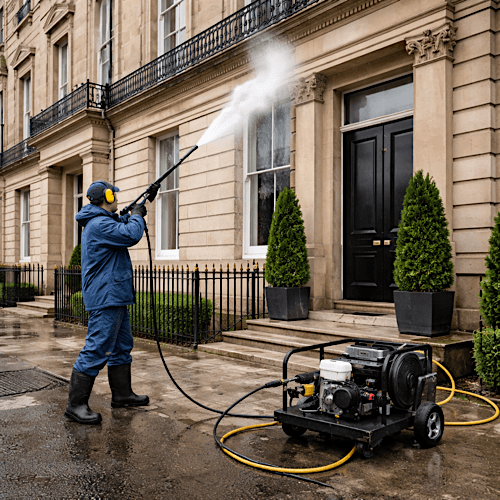
Our professional facade jet washing targets the specific deterioration patterns on each elevation, delivering comprehensive cleaning results.
Pollution staining on building facades across Newcastle, Sunderland, and the region’s urban centres creates progressive darkening. This dramatically alters the building’s appearance. Sulphur dioxide and particulate deposits bond chemically with stone, render, and brick surfaces. These deposits form adherent crusts that resist rainwash. Professional jet washing with appropriate chemical pre-treatment breaks these bonds. It removes pollution films that may have accumulated over decades, revealing the original material colours beneath.
Biological growth on facades presents both aesthetic and structural concerns. Algae discolouration is the most visible impact, turning clean surfaces green, black, or red depending on the species. More seriously, moss and lichen root systems penetrate surface pores, causing micro-cracks that admit moisture and accelerate freeze-thaw damage during North East winters. Removing ivy and other climbing plants from facades often reveals significant underlying damage. Professional jet washing removes all biological growth and treats surfaces to inhibit rapid recolonisation.
Facade cleaning frequency depends on building location, orientation, material type, and local environmental conditions. Properties in sheltered, shaded locations across County Durham’s wooded valleys require more frequent cleaning. Exposed buildings on Northumberland’s windswept coast need cleaning less often. Urban facades in Newcastle and Sunderland accumulate pollution faster than rural properties across Teesside’s agricultural areas. Professional cleaning companies assess these factors. They recommend appropriate cleaning schedules for each building.
Health and safety management during facade jet washing operations often requires specialist access equipment. Scaffolding, mobile elevated work platforms, and rope access techniques each have applications. The choice depends on building height, access constraints, and cleaning requirements. Professional operators serving the North East hold appropriate safety certifications, equipment qualifications, and insurance coverage for elevated working.
Facade jet washing also supports building energy performance. Contaminated cladding and glazing reduce natural light transmission, thereby increasing the need for artificial lighting. Solar gain through clean glazing reduces heating demands. These energy benefits, while modest individually, contribute to building operational efficiency across large commercial properties throughout the North East.